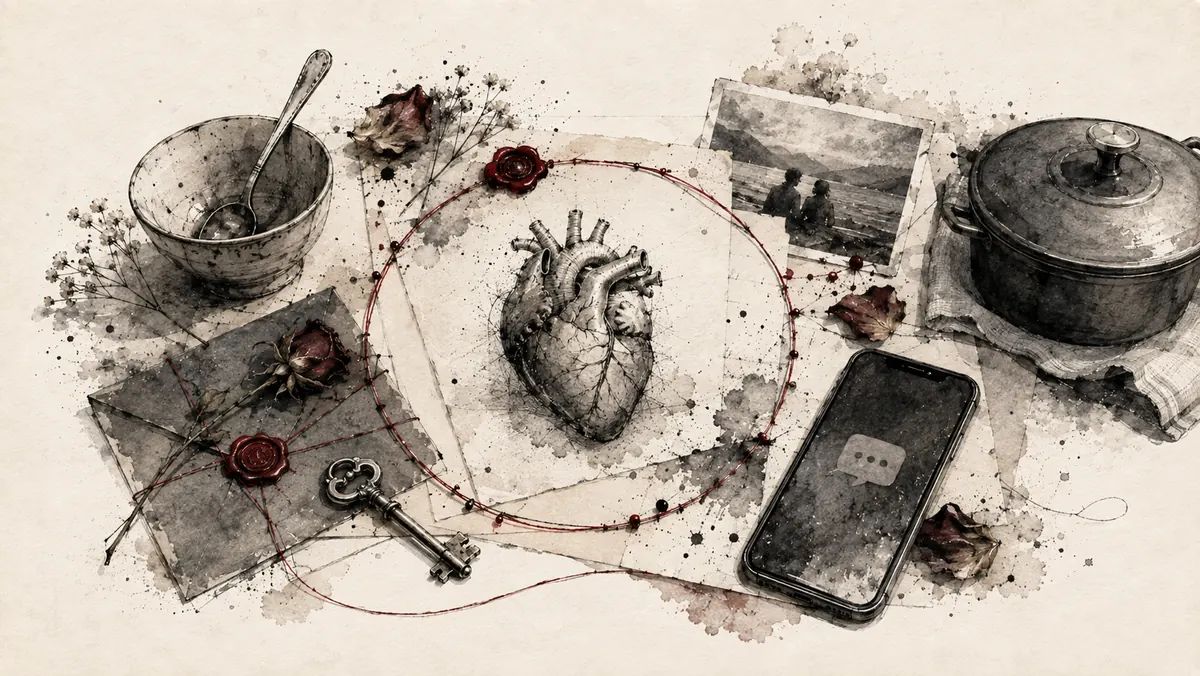
WhatsApp puts a grey bar across a thread when you have missed something. 1 unread message. The bar carries no other information. Who sent it, and the fact that the entry directly beneath it is from March 2012 and concerns a box of books and who was going to collect it, are things you find out after you tap. The counter runs to one and stops. Something has arrived and has not been looked at, and the app will hold that number in front of you until you look at it.
09:56, Sunday. I was standing at the open fridge deciding whether the courgettes were still a vegetable or already a decision.
The message said that leaving me was probably the biggest mistake of their life. It said they hoped I knew how much I had been loved and appreciated. A red heart at the front and a red heart at the end, which is how you punctuate something you have been carrying for a long time and have decided to put down in one movement.
Fifteen years earlier, that paragraph would have rearranged the furniture in my head for a month.
I read it twice, closed the fridge, and stood in the kitchen for long enough that the fridge started its noise again.
There are messages you draft for years without opening an app.
You compose them on the last train, in the four minutes before sleep when your defences have already clocked off. The person who hurt you finally understands. They arrive with the explanation, and the explanation covers everything: that you counted, and that the leaving was the error.
And you rehearse the reply. You itemise. You go through the whole list in order, calmly, and they take it. Or you leave it on read and let the two blue ticks do the work, which is the version most of us would actually pick.
Then the years do what years do to a rehearsal. You stop running it. It stays in the building, somewhere near the back, undusted.
And then one ordinary morning it arrives, in the same app you use to arrange dentist appointments.
The answer arrived after the question had been withdrawn
When that relationship ended, I was left with a set of questions that anyone who has been left by somebody they still wanted will recognise.
Why wasn't I enough. What did the other person have. Had I stopped being attractive at some specific point I could have identified if I had been paying attention. Had I misread the entire arrangement from the beginning.
The unanswered ones are the dangerous ones, because the field does not stay empty. You fill it in yourself, at 02:00, using whatever is closest to hand, and what is closest to hand at 02:00 is never generous.
Somebody else's confusion, withdrawal, fear, or straightforward inability to say a true sentence out loud goes into the field as a finding about you. If they did not choose me, something in me was the reason they could not.
It is an efficient piece of reasoning. It is also, most of the time, wrong in a way that takes about a decade to establish.
Here is the part I could not have known in 2011. The person who left me spent the following years working out who they were, and that work included a transition. Some of what was inexplicable at the time has a mechanism now.
That does not revise what happened. The months afterwards were what they were, and they stay spent. It means the account I wrote at the time was assembled from the pages available, several pages were missing, and I signed it anyway and filed it as final.
Closure has terrible punctuality
We talk about closure as though it were something another person hands across a table. One last conversation, or one apology sincere enough to click the whole shape into place.
If closure required the cooperation of the people who damaged us, most of us would be on a list for life.
What actually happened is duller than that and took longer. I built a life in which the question stopped being load-bearing. I moved. I got worse, then slightly better, then worse again in a different way. I got into the habit of writing at the kitchen table on Saturdays. I put two books out and left a third in a folder. Somewhere in there I stopped opening that thread, and I stopped checking, and the last time I looked at the profile photo it was already three phones ago.
You recover without the explanation, or you do not recover. Those are the available routes. The apology is a nice-to-have that arrives, when it arrives, as a courtesy to somebody who no longer requires the service.
I had already survived the absence of those words. By the time they arrived they were a receipt for something long since paid.
Some apologies are only apologies
Retrospective regret opens a door, and behind the door is an entire alternate flat, furnished.
What if we had stayed. What if we tried it again now, with the corrected file.
A circle can close without becoming a roundabout.
Two people sometimes have to come apart because neither of them could become the person they were going to be inside the arrangement they had built. People change. Bodies and identities and countries change with them, and occasionally change back. In between, we fall for other people and pay a therapist to hear us say the obvious out loud.
Fifteen years is a life.
The person who read that message on Sunday is fifteen years downstream of the one who needed it. Whoever sent it has presumably travelled the same distance.
The wrong file
I was sometimes the problem. I have stayed in rooms I should have left, and behaved badly with full access to better options. There is a third book in a folder that does nothing except ask whether I might, in fact, be the red flag. The jury remains delightfully inconvenienced.
The self-implication goes further than the anecdotes, though. I ran the same system they did. I kept the thread and told the story in whichever order was most usable to the room I was in, which is a way of curating an archive while calling it memory. I took a private construction site somebody else was standing in and read it as a verdict on me, which is a way of keeping yourself at the centre of an event that was mostly happening to somebody else.
They were sealed. So was I.
What arrived on Sunday was a small piece of information from the other side of an old file. I had been loved. I had been appreciated. I had been a decent partner. The version of me who needed that would have carried it around for months and produced it in arguments.
The current one typed and deleted four replies, and sent a short one that wished them well. First message in the history of that thread with no question in it.
What closing a circle looks like
I stayed out of the alternate flat. What came instead was smaller and stranger than triumph.
Mostly I thought about the twenty-something in that relationship who was working from partial information, took personally a thing that was mostly weather, and then spent years turning himself into somebody the missing pages could no longer reach.
If there were an address for him I would send two lines. You are going to be all right. The words are coming, eventually, and by the time they land you will already have built the thing that makes them optional.
Sometimes closure arrives fifteen years late, knocks politely on a life that has been finished and furnished without it, and finds nothing to repair.
So you close it. You wish each other well.
The grey bar is gone. WhatsApp counts only what you have yet to open; once you look, its work is done. The courgettes were fine. I made the thing with the courgettes.
For the longer record of what the aftermath actually costs to keep, read Terms of Living. On keeping an honest sequence of events, read The Receipt, and on the archive as a survival habit, Save As.
The full aftermath is in Terms of Living
Terms of Living is five movements through the aftermath of modern love: the breakup that ends calmly, the body that keeps score anyway, and the conditions that remain once you stop waiting for anyone to explain you to yourself.
Explore Terms of Living →